A full text and illustrated version of the Post which preceded this.
https://www.nkwazimagazine.com/the-art-of-memory-loss-and-resistance/
/

Ruth's retrospective art exhibition 'Unravelling' has been on at the Lechwe Trust Art Gallery in Lusaka, Zambia, from 15th. October to 16th. November. It has been very well received, with several hundred visitors and well over half of the works sold.
Here's a review of the exhibition which will be appearing shortly:-
Ruth
is heavy.
If you have
milled around Zambia’s art and history circles, you may know of her. She is a
repository.
I first
encountered Ruth as I was researching a project. I find I often come across her
archive of written musings whenever I do some in-depth research on Zambian art.
Frankly, I thought she was dead.
Her latest
show, the first in decade is vulnerable and raw, and not for the faint of
heart. ‘Unravelling’ skips over the niceties and goes straight for the jugular,
disrupting and upending what Zambian art could be on its head as she returns to
where art really began for her. Gone are the vibrant colours reminiscent of
chitenge fabric and colourful representations of tradition. Amid a sea of
black, white and grey, colour shines through, but the perfunctory introduction
of colour to this exhibition is not without intention, there is a formula to
it. None of Ruth’s work
made me happy, and therein lies my own contradiction of my own divided
perceptions of art. The art we view, is informed by the times.
Ruth Hartley
has been part of Southern Africa’s fabric since her birth in Harare, Zimbabwe
in 1943, she has lived and created art between Zambia, Zimbabwe, South Africa
and Europe. She studied art at the Michaelis School of Fine Art in Cape Town
and later received her MA in Women’s Studies from Anglia Ruskin University in
1999. She moved to Zambia in 1972 and ran Mpapa Gallery alongside Lechwe Trust
Gallery founder Cynthia Zukas for ten years from 1984 to 1994. These years,
often considered the golden age of Zambian art, were instrumental in helping to
direct the future of Ruth’s approach to her art practice.
As with most
artists, Ruth’s works are informed by the times, except Ruth has always
gravitated to the political, vulnerable and unvoiced. One of her earlier works,
‘Chikumbi Bombings, 1979’, depicts the bombing of Chikumbi in the late 1970s,
when during Zimbabwe’s liberation struggle, when Ian Smith deployed Rhodesian
forces near Chisamba. At first glance, the colours are bright and vibrant.
Crimson red, velvet greens and deep yellows create an orderly, almost practiced
composition. On closer inspection, these are bodies in various positions of
prostration and despair beneath the shade of a tree crowned with red and gold
flowers. The flowers are flaming tongues of fire. There are buildings aflame.
The bodies are not lounging, they are those of the deceased and those who mourn
them, caught in the crossfire. Despite its raw messaging, the image fulfills
the criterion of an aesthetic image. Neatly ‘coloured within the lines’, a
dirge disguised as a tableau. In this image, is Ruth still finding her way? Not
yet vulnerable, not yet come to meet herself?
The
Unravelling brings 150 out of 245 paintings, sketches and installations out of
hiding. Sana Ginwalla, curator, archivist and founder of the Everyday Lusaka
Gallery in Lusaka, Zambia, curates what we see, and how and when we see it. We
approach ‘Chikumbi Bombings’ before the abrupt steeliness of the ‘Migration 1’
and ‘Migration 2’ series enters our periphery and keeps our attention.
Ginwalla’s choice of juxtaposition is not without intention. The spectrum of
colours flows throughout the exhibition. The first series, ‘The True History of
My Past’ is drenched in vibrant colour, a collection of whimsical, almost crude
sketches, to stark black and white sketches depicting the realities of Zambia’s
ongoing relationship with drought and climate change, before turning a corner
to a piece from her ‘Apartheid Series’, drenched in blood-red and created in
the Mbile International Artist’s workshop addressing apartheid and its
conclusion in South Africa. The coffins at the bottom of the painting are a
precursor to the cold, dark, grey steel of iron, metal and war, shot with red
for blood, fire and restriction in the ‘Migration Series’, chronicling the
plights of Syrian refugees. These later works, in contrast to ‘Chikumbi
Bombings’, reveal a more honest stroke that demonstrates Ruth’s anguish,
loneliness, pent-up emotion and empathy for human life.
What strikes
me about Unravelling, is the linework. It is bold, intimidating and purposeful.
Her strokes remind me of the pains of labour. This work is birthed through the
pain and adversity of her life, and this form of pain is raw and visible in
nearly every piece. Forced into political exile after freeing apartheid South
Africa for having a interracial relationship and subsequently experience
financial and emotional abuse in her first marriage, followed by a divorce that
disrupted her family life and that of her children, Ruth bears down in
Unravelling and enters the second stage of labour.
From here,
the curation draws into the ‘heart’ of the exhibition, Ruth’s heart, where we
meet her most intimate and vulnerable self. So far, we have experienced her
from the outside, as ‘WWW Woman’, spun out of hessian and unravelling over the
years and we have experienced her depictions of the struggles of others, Syrian
refugees losing their lives escaping wars in tube boats and the effects of
drought. In the heart, Ruth depicts herself in the flesh. We find her body
discarded on the floor, her skin flayed and spread out like a cattle hide
drying, to reveal…nothing. We walk all over and past her body like she means
nothing, just a discarded object of no importance. She is unsettling.
Above her
discarded remains, a mythical creature, ‘The True History of My Body’, with
multiple eyes escaping its head and five arms clutches various objects
associates with her life, travel, motherhood, relationships, art, an impaled
ankle from many years ago and a hole in her belly: a miscarried pregnancy. Her
heart is arranged with what she loves and what she has lost. Pieces of a
disintegrating door in ‘The Past Future Tree’ bears the disintegrating
portraits of her family tree, as her ancestors fade away, so do the
photographs, so do the salvaged remains of a discarded door. A piece, ‘Life’s
Journey Making Roads’ hangs in a corner. It is a collection of debris collected
with her husband during a long road trip depicting the things we pick up along
the way that become a part of us. In the ‘Love ‘series, Ruth also confronts
heartbreak, grief and those she holds dear with a sobering collection of
sketches titled ‘Love’. There is not much to love as the collection is
unsettling, not at all betraying the imagery we have come to associate with the
verb. In ‘Love’, the artist appears haunted and in anguish, mirroring our own
struggles with the implications of loving, being in love and receiving love.
The
walkthrough ends with a 5-panel display titled ‘RA1TZ’. It depicts a recreation
of one of the world’s most chilling images, a man falling from the World Trade
Centre during its collapse on 9/11. Unravelling leaves behind a bitter taste.
It steps outside the boundaries of what art should be or could be. Viewing the
exhibition is not a pleasant experience, Ruth takes the worst of society and
holds a mirror back to it: war, violence, geopolitics, death. Herself an
advocate for political and social change, she once considered herself a
Marxist, and has been involved in the Vietnam War protests, Women’s Rights
Movements, a member of the ANC Youth Wing during her time in South Africa.
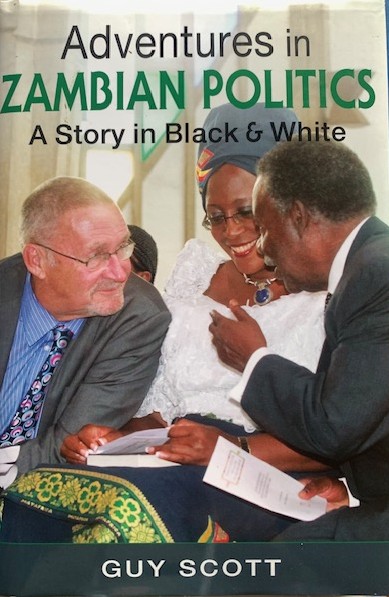
Dr Guy Scott, former Vice-President of the Republic of Zambia, died on Wednesday 15th July 2026, at the age of 82. The President of Zambia, Hakainde Hichilema has honoured Dr Scott by 5 days of national mourning and a State Funeral on Monday 20th July, 2026.
Guy Scott was a long-standing friend of mine and of my first husband, Dr Mike Bush. We met in 1973 at Callum Christie’s home on Leopards Hill, 53 years ago. Callum was Guy’s partner in the first strawberry export business in Zambia at Walkover Estate by the then new international airport. I remember Guy striding up to the house already talking away while Manja, his lovely Croatian wife, followed behind loaded down with huge boxes of strawberries for our lunch.
I had just met Guy’s old Peterhouse schoolfriend , John Fynn. John’s dog was called Wedza after the place I had lived in in Rhodesia, and I gathered that Guy’s political opinions had caused him problems at this posh Rhodesian school. I knew I was in trustworthy company as my London friends were South African exiles and members of its African National Congress. I had chosen to come to Zambia so that my children would not be subject to the racism of Rhodesia where my family lived, but the Southern African Liberation wars had begun, borders had been closed, political problems and food shortages were increasing.
Life was not easy, but our friendship with Guy and Manja and their friends grew and sustained and enriched us. Mike did regular health clinics for the strawberry farm workers at Walkover. The artist, Cynthia Zukas, another friend, made drawings and etchings of the workers. Guy’s brain was always fizzing away with economics, politics and ideas of social change, all stuff I loved to discuss and argue about. Guy built a lovely house for Manja on the hilltop at Walkover. I remember standing on the veranda with Guy and Manja’s son Sasha, as a Rhodesian fighter plane did a Victory Roll a few feet over the house on its way to terrorise the airport. The Rhodesians had just bombed a ZAPU campsite killing 100s of people. They had also tried to kill the ZAPU leader, Joshua Nkomo, whose Lusaka house was near ours.
Guy was the centre all our friends circulated around and fell in love with. The strawberry business was successful, and Guy and Callum may have been among the first kwacha millionaires. Manja and I used Callum’s house as an art studio together when Callum moved out. We spent time together and so did our children. I, however, had a solo art exhibition at Mpapa Gallery, and all our lives began to change.
The Scotts went to Spain briefly, then to Lewes in England, and finally Guy was given a research fellowship in Oxford. Mike and I caught up with them in London and in Oxford. It was an sad time for Guy and Manja, much as they loved each other, they were very different people. Guy had written a Sci-Fi book, but it fizzed like his brain with too many ideas. He was also very unhappy with his Oxford work and said something like- “It is about giving weapons vision so they can kill. I don’t want to be part of it.” Manja and Guy divorced and Guy came back to the Zambia he loved.
Zambia was in crisis economically and politically. President Kenneth Kaunda, fundamentally a good and modest man and worker for African freedoms, had nationalised the mines, but also made a One-Party State during the difficult years of the liberation wars. Zambians were angry and the students rebelled, riots started everywhere. I had to drive back from the airport under armed protection and flying bullets. At one point, rioters in the city stampeded and looted shops. Mike’s clinic was closed and so was Mpapa Gallery where I was working. My daughter, Tanvir, was rescued by my gallery secretary from an army round-up. President Kaunda wisely agreed to step down after 27 years and reinstate democracy. Guy again devoted himself to politics and to serving for the Zambian people and he joined with Frederick Chiluba’s party.
Guy had moved to his Trotover Estate, so named because it was a pig farm. Sadly, President Kaunda had accepted a gift of pigs from abroad and unintentionally brought swine fever into Zambia. Guy’s farm was infected and he had the dreadful and shocking job of slaughtering and burning 1000s of pigs. After that painful horror, Trotover would become an equestrian centre under Karen Wallace.
Changing Zambian politics was extremely challenging and even dangerous. It was 1991. After a quarter century without democracy Zambians had riots rather than campaigns and after several months Guy looked as if he had PTSD and no sleep. All through it, however, he had the intelligent and pragmatic support of Charlotte Harland. They married in 1994. Mike and I were pleased to help with the wedding and the food. Ironically this was also the time I divorced Mike and left Zambia and sadly after this I saw little of Guy and Charlotte, though I kept in touch with Zambia through my art and my children. Zoe worked in the Luangwa Valley, Tanvir made two documentary films in Zambia, one about street-kids, the second about Mike’s work with HIV/AIDS at Chilanga hospice.
Under President Chiluba, as Minister of Economics, Guy Scott did a significant and important job of finding food for a hungry Zambian nation at the height of the HIV/AIDs epidemic. Some years later I watched the State Funeral of Nelson Mandela on TV and was impressed to see Guy, the Acting President of Zambia after the death of President Michael Sata, help Kenneth Kaunda pay his respects to Mandela. This was Zambia at its best. I was also delighted and amused to see Acting-President Guy and First Lady Charlotte meet Barack and Michelle Obama in America, another wonderful moment in world history.
My family owe Guy Scott a huge debt of gratitude for all he did for Mike’s funeral in 2012. Tanvir had had to deal with the very sad complications of end-of-life arrangements for Mike in South Africa, but Guy helped with the flight for the return of Mike’s body for the funeral and both he and Charlotte made arrangements for Mike’s Memorial service and a reception at the State Office.
My journalist friend, Michael Holman and my journalist grandson, Stephen K Bush reviewed Guy’s book Adventures in Zambian Politics a Story in Black and White. It is a fascinating book about his experiences and dedication to Zambia. I spent time with Guy and Charlotte on my last visit to Zambia to see my family. I had hoped to see him again in October when I return to Zambia for my art exhibition at the Lechwe Art Gallery but sadly that will not happen. Guy’s long-standing friend, Alan Cowell has written an excellent obituary for Guy in The New York Times. https://www.nytimes.com/2026/07/15/world/africa/guy-scott-dead.html
Guy Scott, you will be remembered by me for being both argumentative and sensible. I loved the fact that you never tried to make Zambia fit any political theories, you always looked at Zambia’s problems and did your best to find solutions that worked and often you got it right.
Well done my old and kind friend!

It's here!
Ruth's latest book (her 10th.!) is out now. It's a compilation of some of her blogs from 2016 to 2026 in which she comments on art, politics, daily news events and a lot more. You may not agree with everything she says - there'd be something wrong if you did - as she doesn't agree with everything she has said herself, but it's an entertainig book to dip into.
Today it has been published as a Kindle (cost about 4 Euros:/Pounds/:Dollars depending on where you order it from).
It will be available in hard copy in a day or two.
Ruth's tenth book is now in the final stages of completion.
You will know (because you are reading this blog) that Ruth has been posting for several years on the subjects of writing, of art, of her life in Africa and Europe and about politics, colonialism and the climate.
She has now produced a work in book form drawn from her Posts from 2016 to the present day. It reflects how attitudes have changed (not only for the better) over the years and offers a new slant on well-travelled topics from one person's standpoint.
Whether you will agree with her or not, keep an eye out for it.
(P.S. You can find more about Ruth Hartley's work on her website: ruthhartley.com)
